| Product Name |
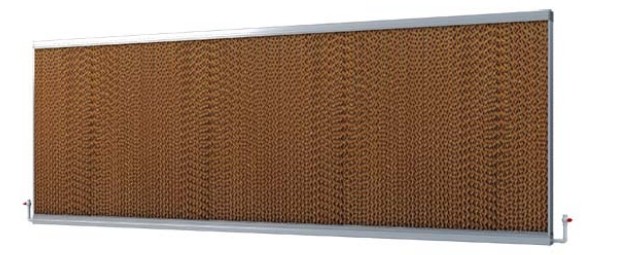
Poultry House Cooling Pad Wall System |
| Product Image |
 |
| Product Overview |
The Poultry House Cooling Pad Wall System is designed to reduce the temperature of incoming outdoor air before it enters a poultry house. The system combines evaporative cooling pads, a water distribution circuit, a supporting frame and a lower water collection arrangement to create a controlled cooling air-intake section.
During operation, water is circulated to the upper part of the cooling pads and flows through the cellulose media. When exhaust fans create negative pressure inside the poultry house, hot outdoor air is drawn through the wetted pads. Part of the water evaporates into the passing air and absorbs heat, allowing cooler air to enter the house.
The system is particularly suitable for poultry buildings using negative-pressure or tunnel ventilation. By coordinating the cooling pad wall with exhaust fans, air inlets, environmental controllers and building sealing, the ventilation system can provide controlled airflow during hot-weather operation.
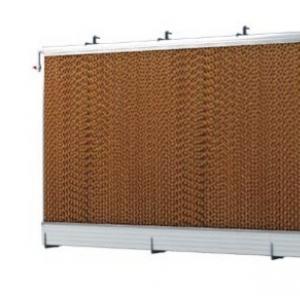
SHEWUYOU's published configuration uses 150 mm treated cellulose cooling pads, 600 mm modular pad sections, anodized aluminum framing, PVC water circulation components and 40-mesh filtration. Overall dimensions are customizable according to the poultry-house opening and ventilation project. :contentReference[oaicite:3]{index=3}
|
| Key Features |
- Evaporative Air Cooling: Uses water evaporation to absorb heat from incoming outdoor air before it enters the poultry house.
- 150 mm Cellulose Cooling Pad: The published SHEWUYOU configuration uses treated cellulose media with a substantial evaporation surface. :contentReference[oaicite:4]{index=4}
- Modular Pad Design: 600 mm wide pad sections support convenient installation, replacement and project-based wall sizing. :contentReference[oaicite:5]{index=5}
- Anodized Aluminum Frame: Aluminum side profiles and water troughs provide a corrosion-resistant structural solution for humid poultry-house environments. :contentReference[oaicite:6]{index=6}
- Uniform Water Distribution: The upper distribution system is designed to wet the cooling media across the required pad surface.
- Integrated Water Circulation: PVC supply and return pipes connect the distribution and collection sections for continuous water circulation. :contentReference[oaicite:7]{index=7}
- Water Filtration: A 40-mesh filtration configuration helps reduce particles entering the water-distribution circuit. :contentReference[oaicite:8]{index=8}
- Rodent Protection Option: Double-sided 304 stainless-steel mesh protection is available as an optional configuration. :contentReference[oaicite:9]{index=9}
- Ventilation System Integration: Designed for use with negative-pressure and tunnel ventilation systems.
- Project Customization: Overall cooling-wall dimensions and layout can be designed according to poultry-house dimensions, airflow requirements and local climate conditions.
|
| Structural Components |
- Evaporative Cooling Pads: Treated cellulose media provides the wet surface required for air-water heat exchange.
- Aluminum Side Frame: Supports the cooling pad sections and forms the main structural interface with the poultry-house wall opening.
- Upper Water Distribution Pipe: Delivers circulating water across the upper section of the cooling media.
- Lower Water Trough: Collects water returning from the cooling pads and directs it back to the circulation system.
- PVC Water Supply and Return Pipes: Provide the water circulation path between the pump, distribution section and collection area.
- Water Filtration Unit: Filters circulating water before it reaches the distribution system.
- Support and Sealing Components: Secure the cooling wall and help minimize uncontrolled air bypass around the pad sections.
- Optional Rodent Guard: 304 stainless-steel mesh can be added according to poultry-house protection requirements.
|
| Working Principle / Structural Principle |
The water pump circulates water from the collection area to the upper distribution pipe. Water flows downward through the cellulose cooling pads, maintaining a wet surface throughout the designed cooling area.
When the poultry-house exhaust fans operate, negative pressure draws outdoor air through the wetted cooling pads. As the air passes through the pad channels, a portion of the water evaporates and absorbs heat from the incoming air. The cooled air then enters the poultry house and moves toward the exhaust side of the building.
The cooling pad wall therefore functions as an integral part of the complete poultry ventilation system. Cooling performance depends on outdoor temperature, relative humidity, airflow rate, pad characteristics, water distribution, building sealing and exhaust-fan capacity.
For tunnel-ventilated poultry houses, the cooling wall and exhaust fans should be engineered as one airflow system so that the required outdoor air passes through the cooling media rather than bypassing the wall.
|
| Technical Specifications |
- Product Type: Poultry house evaporative cooling pad wall system
- Cooling Method: Direct evaporative cooling
- Cooling Pad Material: Treated virgin-pulp cellulose paper
- Cooling Pad Thickness: 150 mm
- Single Pad Width: 600 mm
- Pad Treatment: Individual sheet curing treatment
- Side Frame Material: Aluminum alloy
- Frame Surface Treatment: Anodized finish
- Water Trough: Anodized aluminum alloy
- Water Supply Pipe: PVC pipe
- Return-Water Pipe: PVC pipe
- Filter Accuracy: 40 mesh
- Filter Housing: ABS
- Filter Screen: 304 stainless steel
- Rodent Guard: Optional double-sided 304 stainless-steel mesh
- Installation: Recessed or external wall mounted
- Overall Dimensions: Customized according to ventilation project
- Airflow Capacity: According to poultry-house ventilation design
- Cooling Performance: According to local climate, relative humidity, airflow and system design
- Power Supply: According to selected pump and local electrical standards
- Operating Conditions: Designed according to local climate and farm conditions
- OEM / ODM: Available upon request
The listed technical specifications are based on the current SHEWUYOU published cooling-pad configuration. Overall wall dimensions and project-specific system parameters are customizable according to ventilation requirements. :contentReference[oaicite:10]{index=10}
|
| Applications |
- Commercial broiler poultry houses
- Layer poultry houses
- Breeder poultry houses
- Duck and other commercial poultry housing
- Large tunnel-ventilated poultry houses
- Negative-pressure poultry ventilation systems
- Hot-climate poultry-house cooling projects
- New poultry-house construction and expansion projects
- Steel structure building poultry projects
- International poultry-farm renovation and agricultural project applications
|
| Customization Options |
- Cooling Wall Dimensions: Customizable according to poultry-house length, wall openings and required airflow.
- Pad Configuration: Pad thickness, module arrangement and total cooling area can be selected according to project requirements.
- Frame Configuration: Frame material and structural arrangement can be adapted to the building environment.
- Water Circuit: Pump, supply pipes, return pipes, troughs and filtration components can be configured according to cooling-wall size.
- Rodent Protection: Optional stainless-steel mesh protection is available according to farm requirements.
- Installation Layout: Recessed or external wall-mounted arrangements can be designed according to building construction.
- Climate Control: Cooling-pad pumps can be coordinated with temperature, humidity, static-pressure and ventilation controls.
- OEM / ODM: Available upon request for distributors, agents and poultry engineering companies.
|
| Installation & Maintenance |
Installation:
- Confirm poultry-house dimensions, ventilation mode, exhaust-fan capacity, cooling-pad area and wall opening before installation.
- Prepare a level and structurally adequate support structure for the cooling-pad frame and water system.
- Install the aluminum frame and verify that it is correctly aligned with the building wall opening.
- Install the cooling-pad modules evenly within the frame and ensure that adjacent sections are properly fitted.
- Install the upper water distribution pipe and confirm that the complete pad surface can be wetted.
- Install the lower water trough, return-water pipe, pump and filtration system according to the water circulation layout.
- Check all pipe connections and fittings for leakage before starting continuous operation.
- Start the water circulation system and verify that water is distributed evenly across the cooling pads.
- Start the poultry-house exhaust fans and confirm that outside air is drawn through the cooling pads rather than around the wall.
- Inspect the system for air bypass, abnormal vibration, water leakage, uneven wetting or drainage problems before commissioning.
Maintenance:
- Inspect the cooling pads regularly for dust, mineral deposits, algae, deformation and physical damage.
- Clean the 40-mesh water filter regularly to maintain stable water circulation.
- Check the upper distribution pipe and outlets for blockage or uneven water flow.
- Inspect the lower water trough and return-water pipe for restricted drainage.
- Use clean water and monitor mineral content to reduce scale accumulation on the cooling media.
- Remove algae, dust and accumulated deposits according to the poultry-house maintenance procedure.
- Do not use excessive water pressure when cleaning cellulose cooling pads.
- Inspect aluminum profiles, PVC pipes, pump components and fastening points for damage or deterioration.
- Inspect optional rodent-protection mesh for deformation, corrosion or damage.
- Allow the cooling pads to dry periodically when operating conditions permit.
- Before seasonal restart, inspect the complete water circulation and ventilation system and confirm uniform pad wetting.
|
| Project Cases |
Illustrative Project Scenario 1 – Broiler House in Southeast Asia
A commercial broiler farm requires high-capacity summer ventilation for several long poultry houses. Cooling pad walls are installed at the fresh-air intake ends and coordinated with tunnel exhaust fans. The total cooling area is designed according to the house dimensions, required airflow and local climate conditions.
Illustrative Project Scenario 2 – Layer Farm in a Hot Climate
A controlled-environment layer house requires stable summer air temperatures during periods of high outdoor heat. A modular evaporative cooling wall is integrated with negative-pressure ventilation, water circulation and environmental controls to provide a coordinated air-intake cooling solution.
Illustrative Project Scenario 3 – Steel Structure Poultry House in the Middle East
An agricultural engineering company develops a new steel structure poultry building with a dedicated cooling-pad wall. The aluminum frame, cooling pads, water circuit and exhaust fans are coordinated with the building envelope and planned tunnel ventilation layout.
Illustrative Project Scenario 4 – Poultry Farm Renovation in Africa
An existing poultry facility requires improved summer cooling without replacing the entire building. A modular cooling pad wall is installed at selected intake openings and connected to the existing exhaust ventilation system, with the cooling area adapted to the available wall space.
The project scenarios above are illustrative engineering applications prepared for product communication and are not presented as completed customer projects.
|
| Product FAQ |
Q1: What is a poultry house cooling pad wall system?
A: It is an evaporative cooling system installed at the fresh-air intake side of a poultry house. It uses wetted cellulose cooling pads to reduce the temperature of incoming outdoor air.
Q2: How does the poultry cooling pad wall work?
A: Water circulates over the cooling pads while exhaust fans draw hot outdoor air through the wet media. Water evaporation absorbs heat from the air before it enters the poultry house.
Q3: Is the system suitable for broiler houses?
A: Yes. It is suitable for broiler houses using negative-pressure or tunnel ventilation, subject to correct engineering of the cooling-pad area and exhaust airflow.
Q4: Can the cooling pad wall be used for layer houses?
A: Yes. It can be configured for controlled-environment layer houses and other commercial poultry buildings according to the ventilation and climate-control design.
Q5: What cooling pad thickness is available?
A: The current SHEWUYOU published configuration uses 150 mm treated virgin-pulp cellulose cooling pads. Other configurations are available according to project requirements. :contentReference[oaicite:11]{index=11}
Q6: What is the width of each cooling pad module?
A: The current published configuration uses 600 mm wide pad modules. The overall cooling wall dimensions can be customized according to the poultry-house ventilation project. :contentReference[oaicite:12]{index=12}
Q7: Can the cooling pad wall be integrated with tunnel ventilation?
A: Yes. The cooling pad wall can be installed opposite the exhaust-fan side and designed as part of a tunnel ventilation system.
Q8: What information is required for a quotation?
A: Recommended information includes poultry type, house length and width, house height, local temperature and humidity, exhaust-fan capacity, available wall opening, required cooling area and project quantity.
Q9: How should the cooling pads be maintained?
A: Regular inspection of pad cleanliness, water distribution, filtration, drainage, pump operation and mineral deposits is recommended. Cleaning methods should avoid excessive water pressure that could damage the cellulose media.
Q10: Can the cooling pad wall be customized for an international poultry project?
A: Yes. Overall dimensions, pad-wall layout, frame configuration, water circulation components, rodent protection and control interfaces can be designed according to project requirements and local climate conditions.
|
| Product Gallery |

 |


Comments & Inquiries
Leave your questions or requirements below. We will reply as soon as possible.