Global Livestock Equipment Manufacturer & Supplier
SHEWUYOU · Livestock Equipment
Integrated Equipment Solutions for Pig, Cattle & Poultry Farms

Wean-to-Finish Wet-Dry Feeder with Water Space

Product Showcase Content
Product Name Wean-to-Finish Wet-Dry Feeder with Water Space
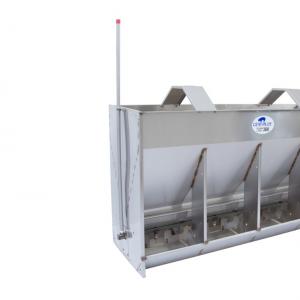
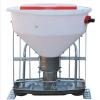
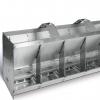
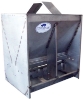
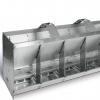
Product Image wean-to-finish wet-dry feeder with water space
Product Overview The Wean-to-Finish Wet-Dry Feeder with Water Space is designed to support pigs from early post-weaning through the finishing stage using one feeding station.

Its two-sided configuration combines adjustable dry-feed delivery, integrated drinking nipples and a dedicated water-access space. During the early nursery period, the water space gives newly weaned piglets convenient access to water while they learn to operate the feeder nipples. After the transition period, this section can be converted into an additional feeding space.

Heavy-duty stainless steel construction, a low trough lip and a protective guard beneath the waterline make the feeder suitable for a wide pig-weight range and intensive commercial wean-to-finish production.
Key Features
  • Wean-to-Finish Application: Designed to serve pigs from the early post-weaning stage through market weight.
  • Dedicated Water Space: Provides young piglets with easy access to water during the initial nursery period.
  • Convertible Feeding Area: The dedicated water section can later be used as an additional feeding space.
  • Two-Sided Feeding: Allows pigs from adjacent pen areas to access the feeder from both sides.
  • Low Trough Lip: Improves access for small newly weaned pigs.
  • Under-Waterline Guard: Helps prevent small piglets from moving underneath the waterline.
  • Wet-Dry Feeding: Pigs can consume dry feed or mix feed and water in the trough.
  • Adjustable Feed Flow: Fine adjustment allows feed delivery to be changed as pigs grow.
  • Integrated Drinking Nipples: One nipple per regular feeding space provides direct water access.
  • Heavy-Duty Stainless Steel: Suitable for repeated washing, humid barns and intensive commercial use.
Structural Components
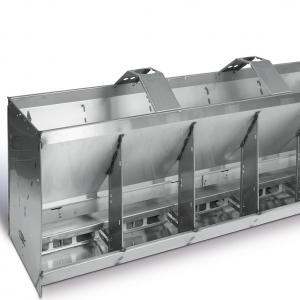
  • Stainless Steel Hopper: Stores dry feed above the controlled discharge system.
  • Two-Sided Feeding Chassis: Provides feeding access from both sides of the unit.
  • Adjustable Feed Gate: Regulates feed movement from the hopper to the feed shelf.
  • Feed Shelf: Presents dry feed before it enters the wet-dry trough area.
  • Trough Divider: Separates functional feeding and watering areas.
  • Dedicated Water Space: Provides direct water access for newly weaned pigs during the transition period.
  • Water-Space Feed Block: Can restrict feed from entering the dedicated water section during initial training.
  • Water-Level Control: A separate water connection and shut-off arrangement can regulate the dedicated water section.
  • Drinking Nipples: Provide water access at regular feeding positions.
  • One-Piece Waterline: Simplifies installation and reduces unnecessary connection points.
  • Mounting Points: Multiple holes and knockouts accommodate different barn installations.
Working Principle During the first stage after weaning, a dedicated water section gives small pigs an easily accessible water source while they become familiar with the feeder and its drinking nipples.

A separate water supply can maintain water in this section while a feed block prevents dry feed from entering it. As pigs learn to use the integrated nipples, the dedicated water supply can be closed and the section converted into an additional feeding position.

During normal operation, dry feed moves from the hopper through an adjustable opening onto the feed shelf. Pigs can consume the ration dry or activate the drinking nipples to mix feed with water in the trough.

The feed opening can be progressively adjusted as pig size, feed consumption and feed characteristics change throughout the wean-to-finish cycle.
Technical Specifications
Product Type Two-sided wean-to-finish wet-dry feeder with dedicated water space
Reference Pig Weight Approximately 6-130+ kg
Main Material 304 series stainless steel
Reference Steel Thickness 16 gauge, approximately 1.5 mm
Construction Welded stainless steel chassis with folded and lapped edges
Reference Feeding Spaces 1-6 spaces per side depending on model
Reference Pigs per Feed Space Approximately 12-16 pigs
Reference Length Range Approximately 375-2172 mm depending on model
Reference Depth Approximately 552 mm
Reference Standard Height Approximately 781 mm
Reference Extended Height Approximately 1035 mm
Reference Feed Capacity Approximately 39-225 kg depending on model and feed characteristics
Water Supply Integrated nipple system plus dedicated water-space supply
Feed Adjustment Fine adjustment; reference system provides approximately 1.5 mm increments
Mounting Options Concrete, concrete slats, plastic flooring or gate mounting
Applications
  • Wean-to-finish pig barns
  • Early post-weaning pig housing
  • Nursery-to-finisher production systems
  • Grow-to-finish pig barns
  • Large commercial pig farms
  • Two-sided pen feeding layouts
  • Automatic dry-feed delivery systems
  • New steel-structure pig houses
  • Existing pig feeding-system renovation projects
Customization Options The feeder can be configured according to pig capacity, feed program and barn layout.
  • Number of feeding spaces
  • Feeder length
  • Hopper capacity
  • Extended hopper configuration
  • Pyramid hopper extension
  • Dedicated water-space arrangement
  • Water-level control system
  • Feed-block configuration
  • Drinking nipple arrangement
  • Inline water regulator
  • Quick-connect water valve
  • Feed tube holders
  • Automatic feeding-line connection
  • Concrete or slatted-floor mounting
  • Plastic-floor or gate mounting
Final specifications are customizable according to pig weight, group size, feed characteristics, water conditions, barn layout and project requirements.
Installation & Maintenance Installation:
  • Confirm feeder size, pig group capacity and location before installation.
  • Position the feeder so both sides have suitable animal access.
  • Select mounting hardware for the existing concrete, slatted, plastic or gate structure.
  • Level and securely anchor the feeder.
  • Connect automatic feed-drop tubes where required.
  • Connect the regular nipple waterline and dedicated water-space supply.
  • Check water pressure, nipple operation and water-space level control.
  • Set the initial feed opening according to pig size and feed characteristics.
  • Verify the water-space feed block and protective guard before introducing small pigs.
Maintenance:
  • Remove accumulated wet or stale feed from the trough.
  • Wash and disinfect stainless steel surfaces between production groups.
  • Inspect the dedicated water space and water-level components regularly.
  • Check nipples and waterlines for blockage or leakage.
  • Inspect the feed-flow adjustment mechanism for free movement.
  • Check trough dividers, guards, welds and mounting brackets.
  • Convert the water space to normal feeding use according to the farm's transition program.
  • Adjust feed flow as pigs grow throughout the production cycle.
Product FAQ

Q: What is the purpose of the dedicated water space?
A: It provides newly weaned pigs with easy access to water before they are fully familiar with the feeder nipples.

Q: Does the water space remain a water-only section permanently?
A: No. After pigs learn to use the regular drinking nipples, the dedicated section can be converted into an additional feeding space.

Q: What pig weight range can the feeder serve?
A: The referenced configuration is designed for approximately 6 kg newly weaned pigs through pigs exceeding 130 kg.

Q: Can it also be used as a grow-to-finish feeder?
A: Yes. The same general feeder configuration can continue to serve pigs through growing and finishing production.

Q: How many pigs can one feed space serve?
A: The referenced system recommends approximately 12-16 pigs per regular feeding space.

Q: Is the feed flow adjustable?
A: Yes. Fine feed adjustment allows feed availability to be changed as pigs grow and feed characteristics vary.

Q: Can the feeder connect to an automatic feeding system?
A: Yes. Feed-tube holders can be incorporated for connection to compatible automated dry-feed delivery lines.

Q: What information is required for quotation?
A: Recommended information includes starting and finishing pig weights, pigs per pen, number of pens, required feeding spaces, water pressure, flooring type, automatic feed-line details and project quantity.

Product Gallery two-sided wean-to-finish wet-dry feeder with water space

dedicated water space in wet-dry pig feeder

wet-dry feeder precision feed adjustment mechanism

wet-dry pig feeder hopper extension options

wet-dry pig feeder floor mounting brackets

Comments & Inquiries

Leave your questions or requirements below. We will reply as soon as possible.