| Product Showcase |
Content |
| Product Name |
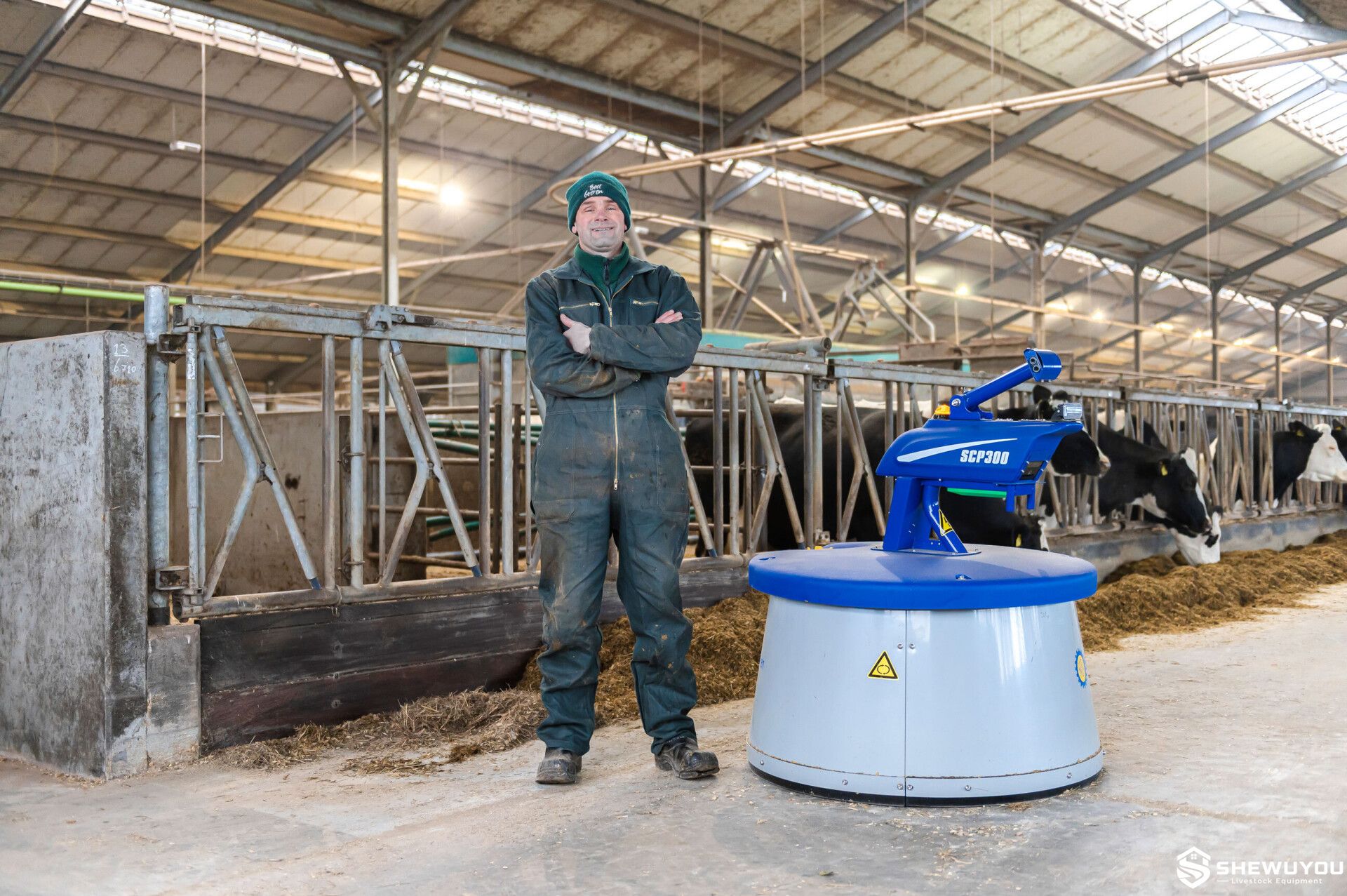
Compact Automatic Feed Pusher Robot |
| Product Image |
 |
| Product Overview |
The Compact Automatic Feed Pusher Robot is designed for autonomous and frequent repositioning of TMR, silage and other cattle feed along dairy-barn feeding alleys. Its compact circular body requires less operating space than many conventional feed-pushing machines, making it particularly suitable for small and medium-sized farms and barns with restricted feed-lane dimensions.
The robot combines visual navigation, ultrasonic sensing and route guidance technology to travel automatically along programmed paths. A rotating drum continuously moves feed back toward the feed fence, helping keep the ration within comfortable reach of cattle throughout the day.
Scheduled operation, automatic return-to-charge functionality and remote monitoring reduce repetitive manual feed-pushing work and allow farms to maintain more consistent feed availability without repeated tractor operation. |
| Key Features |
- Compact 1080 mm diameter body suitable for restricted cattle-barn feed alleys.
- Automatic scheduled feed pushing reduces repetitive manual labor.
- Visual navigation identifies the feeding area and supports autonomous route adjustment.
- Ultrasonic sensing assists navigation and obstacle detection.
- Rotating drum continuously returns TMR and loose forage toward the feed fence.
- Two high-power brushless drive motors provide stable movement under varying feed-lane conditions.
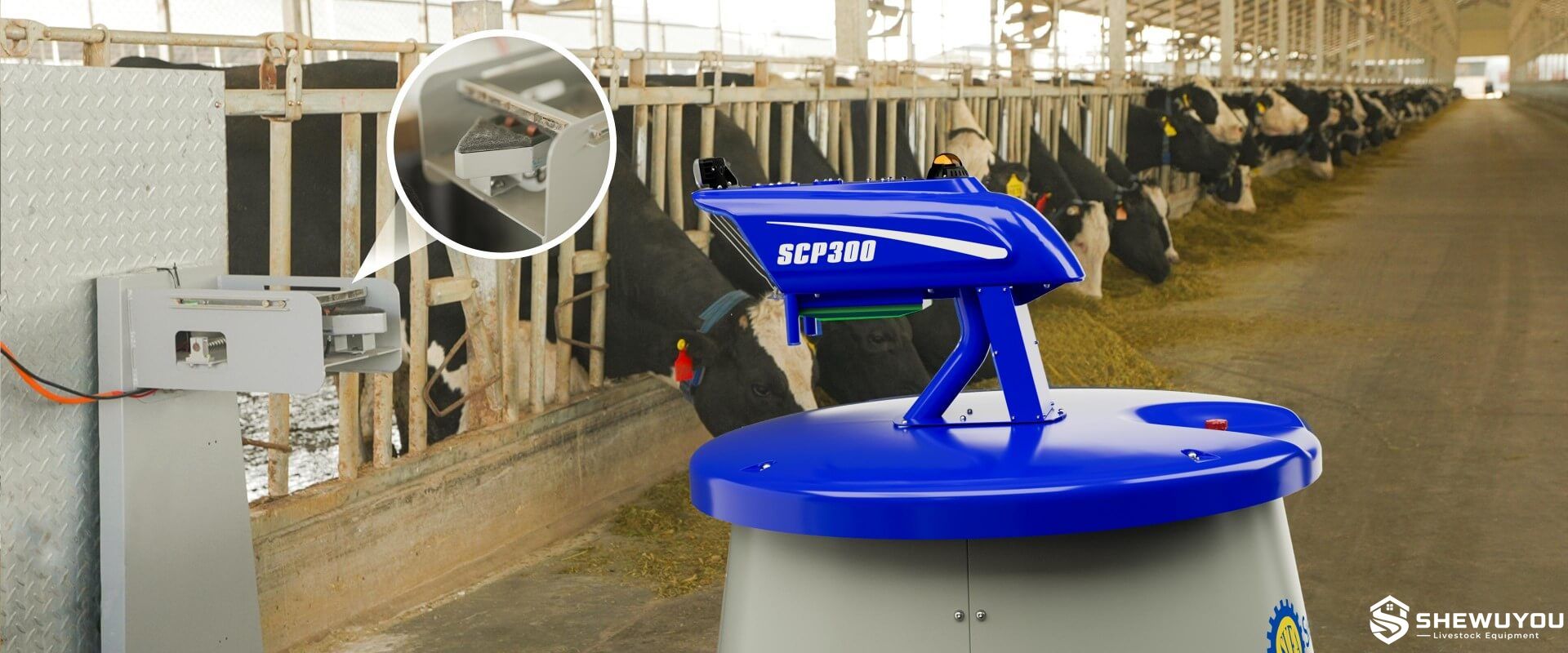
- Automatic charging allows the robot to return to the charging station after scheduled tasks.
- Remote monitoring and task management support convenient farm operation.
- Compact charging station reduces installation space requirements.
- Quick-release drum and self-cleaning charging contacts simplify routine maintenance.
- Electric drive produces no engine exhaust inside livestock buildings.
- Suitable for high-frequency feed-pushing schedules throughout the day and night.
|
| Structural Components |
- Rotating Feed Drum: Circular working section pushes and rolls loose feed toward the cattle feeding line.
- Vision Module: Camera-based sensing supports route recognition, navigation and environmental monitoring.
- Ultrasonic Sensors: Assist obstacle detection and safe movement around the barn.
- Drive Motors: Dual electric motors provide independent traction and maneuverability.
- Drive Wheels: Two powered wheels control forward movement and steering.
- Support Wheel: Third wheel stabilizes the chassis during operation.
- Lithium Battery Pack: Supplies energy for propulsion, navigation and feed-pushing functions.
- Automatic Charging Interface: Connects with the charging station without routine operator intervention.
- Emergency Stop: Provides immediate manual shutdown when required.
- Control System: Coordinates navigation, task scheduling, motor control and charging management.
|
| Working Principle |
Feed-pushing routes and operating times are configured during system commissioning. At the scheduled time, the robot automatically leaves the charging station and travels toward the assigned feeding alley.
Visual navigation and auxiliary sensors help the robot identify its operating path and respond to obstacles. As the robot moves along the feed fence, the rotating drum contacts loose TMR or forage and gradually pushes it back toward the cattle.
After completing the programmed route, the robot automatically returns to the charging station. Charging is managed by the onboard control system so the machine can prepare for the next scheduled feed-pushing cycle. |
| Technical Specifications |
| Equipment Type |
Compact automatic feed pusher robot |
| Reference Model |
SCP300 configuration |
| Feed-Pushing Method |
Rotating drum |
| Diameter |
1080 mm |
| Working Height |
1120 mm |
| Transport Height |
665 mm |
| Reference Weight |
410 kg |
| Maximum Travel Speed |
18 m/min |
| Maximum Permissible Slope |
6° |
| Working Temperature |
-20°C to 50°C |
| Number of Wheels |
3 |
| Drive Wheels |
2 × Ø250 × 80 mm |
| Drive Motor Quantity |
2 |
| Drive Motor Power |
400 W each |
| Navigation |
Visual navigation with ultrasonic assistance and magnetic guidance where required |
| Obstacle Detection |
Visual obstacle detection with auxiliary sensing |
| Battery Type |
Lithium battery; final configuration may vary by market requirements |
| Battery Voltage |
48 V |
| Battery Capacity |
40 Ah reference configuration |
| Charging Method |
Automatic return and charging |
| Charger Input |
220 V, 45–65 Hz reference configuration |
| Remote Management |
Available |
|
| Applications |
- Small and medium-sized commercial dairy farms.
- Free-stall dairy cattle barns.
- Beef cattle facilities with suitable feed alleys.
- TMR feeding systems requiring frequent feed repositioning.
- Barns with restricted space for tractors or larger feed-pushing equipment.
- Livestock farms seeking automated 24-hour feeding support.
- Existing cattle barns undergoing automation upgrades.
- New steel structure cattle-barn projects with automated feeding systems.
|
| Customization Options |
- Battery Configuration: According to destination-country requirements.
- Charging Specification: Customizable according to local electrical standards.
- Route Configuration: Programmed according to barn and feed-lane layout.
- Feed-Pushing Schedule: Adjustable according to feeding management requirements.
- Remote Management: Available according to communication and project requirements.
- Navigation Layout: Configured according to building layout and operating routes.
- Project Integration: Can be coordinated with feed fences, TMR feeding equipment and cattle-barn layouts.
- Environmental Adaptation: Designed according to local climate and farm conditions.
|
| Installation & Maintenance |
- Survey the feed alley and define operating routes before commissioning.
- Install the charging station on a stable, suitable surface with the required electrical supply and grounding.
- Keep the charging station protected from unsuitable environmental exposure.
- Configure routes and scheduled feed-pushing tasks during system commissioning.
- Keep the vision module and sensors clean for reliable navigation.
- Inspect the rotating drum regularly and remove wrapped twine or foreign material.
- Check wheels, fasteners, charging contacts and safety devices periodically.
- Use appropriate cleaning methods and avoid direct high-pressure washing of sensitive electrical components.
- Keep battery and charging components dry and inspect electrical connections regularly.
- Service or replace electrical and safety components through qualified personnel when required.
|
| Project Cases |
Manufacturer-reported field applications include dairy farms in Germany, Poland and Sweden. Reported operational benefits include reduced daily manual feed-pushing time, more frequent feed availability and reduced feed waste.
Actual performance depends on herd size, ration characteristics, feed-lane geometry, pushing frequency, barn management and other operating conditions. Feed intake or production improvements should therefore be evaluated according to each individual farm. |
| Product FAQ |
Q: What type of feed can the robot push?
A: It is suitable for common cattle rations such as TMR, silage, chopped forage and other loose feed distributed along a feed fence.
Q: Does the robot operate automatically?
A: Yes. Feed-pushing routes and operating times can be programmed so the robot completes scheduled tasks automatically.
Q: How does the robot navigate?
A: The reference configuration uses visual navigation supported by ultrasonic sensors and magnetic guidance in selected route sections.
Q: Does it return to the charging station automatically?
A: Yes. After completing a task or when charging is required, the control system can guide the robot back to its charging station.
Q: Is the robot suitable for narrow barns?
A: Its compact 1080 mm diameter helps reduce space requirements, but final suitability depends on feed-lane width, turning areas and other barn dimensions.
Q: Can the robot be monitored remotely?
A: Yes. Remote operating and monitoring functions are available with the appropriate communication configuration.
Q: Can it work in cold or hot climates?
A: The referenced working temperature range is -20°C to 50°C. Project conditions should still be reviewed before installation.
Q: Can the system be configured for an overseas cattle-farm project?
A: Yes. Charging specification, operating routes, feed-pushing schedules and project integration can be configured according to local farm requirements.
|
| Product Gallery |
 |


Comments & Inquiries
Leave your questions or requirements below. We will reply as soon as possible.