| Product Name |
Low Pressure Gas Radiant Brooder |
| Product Image |
 |
| Product Overview |
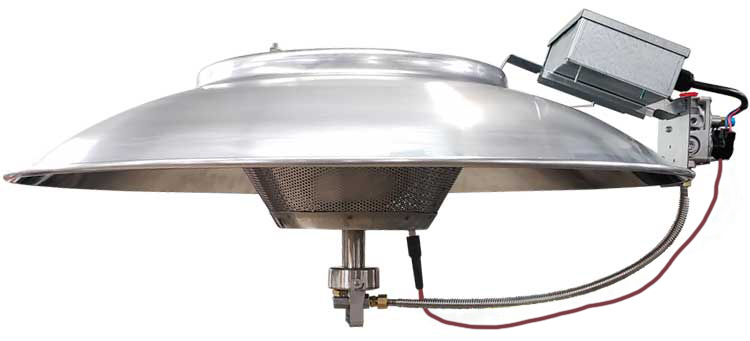
The Low Pressure Gas Radiant Brooder is designed for localized heating in commercial poultry houses and other suitable livestock buildings. Instead of relying primarily on heating the entire air volume, the radiant emitter directs thermal energy toward birds, litter and floor-level surfaces to create a comfortable brooding zone.
The unit typically combines a gas burner, radiant emitter and wide reflector canopy in a suspended structure. The reflector helps distribute infrared heat across the production floor, while the low-pressure gas supply configuration is suitable for centralized poultry-house gas systems designed according to local regulations and project requirements.
For commercial poultry production, radiant brooders can be integrated with temperature sensors, zone controls or a house environmental controller. Correct coordination between heating equipment and the livestock ventilation system helps provide the required brooding temperature while maintaining fresh-air exchange and indoor air quality.
SHEWUYOU supplies project-oriented brooding heaters for broiler farms, breeder houses, turkey farms, poultry farm construction and integrated agricultural project applications. Gas type, heat output, ignition method, suspension arrangement, control interface and accessories can be configured according to project requirements.
|
| Key Features |
- Radiant Floor-Level Heating: Infrared energy is directed toward birds and litter to create a concentrated brooding comfort zone.
- Wide Heat Distribution: A large reflector canopy helps spread radiant heat over the required poultry production area.
- Low-Pressure Gas Operation: Suitable for poultry-house gas supply systems designed for low-pressure brooder applications.
- Flexible Fuel Options: LPG / propane or natural gas configurations can be supplied according to project requirements.
- Multiple Ignition Options: Spark ignition or other suitable ignition configurations are available upon request.
- Environmental Control Integration: Can be coordinated with thermostats, zone controls or poultry house environmental controllers.
- Corrosion-Resistant Components: Suitable material options can be selected for humid and dusty agricultural environments.
- Simple Suspended Installation: Compact hanging design keeps heating equipment above the bird production area and helps preserve usable floor space.
- Service-Friendly Structure: Accessible burner, emitter, gas-control and ignition components support routine inspection and maintenance.
- Commercial Farm Configuration: Suitable for poultry farms, livestock equipment distributors, agricultural engineering companies, agents and project buyers.
|
| Structural Components |
- Reflector Canopy: Directs radiant energy downward and outward to form a broad heating pattern at floor level.
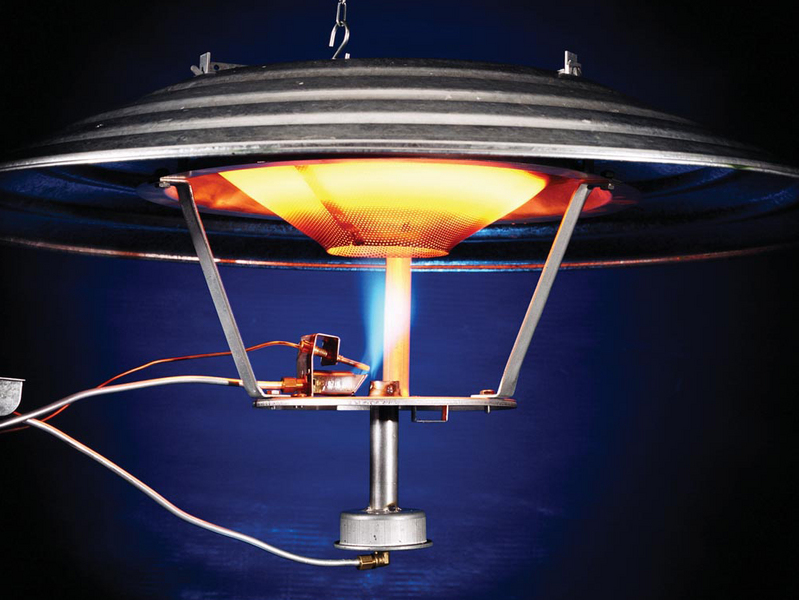
- Radiant Emitter: High-temperature emitter converts burner heat into infrared radiant energy.
- Gas Burner Assembly: Mixes fuel gas with combustion air and generates the heat required by the radiant emitter.
- Gas Control Valve: Controls fuel delivery according to the selected ignition and operating configuration.
- Ignition System: Spark ignition or other project-specific ignition system starts the burner safely.
- Gas Orifice / Fuel Configuration: Selected according to LPG / propane or natural gas requirements.
- Control Enclosure: Protects ignition and electrical control components where applicable.
- Suspension Assembly: Chain, cable or other hanging hardware supports the brooder at the designed height above the poultry floor.
|
| Working Principle / Structural Principle |
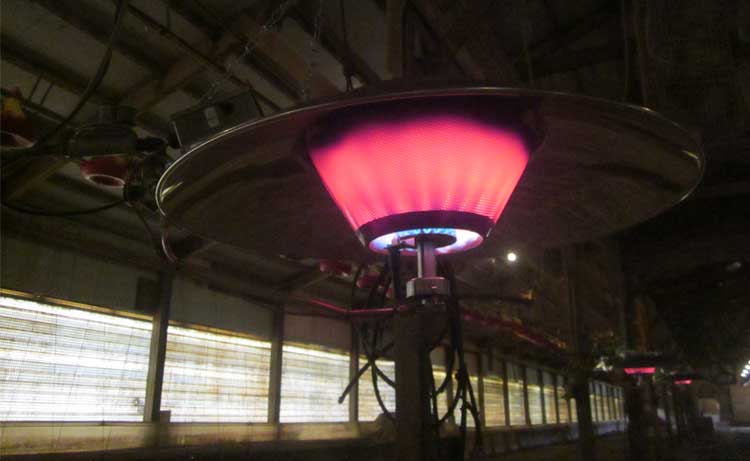
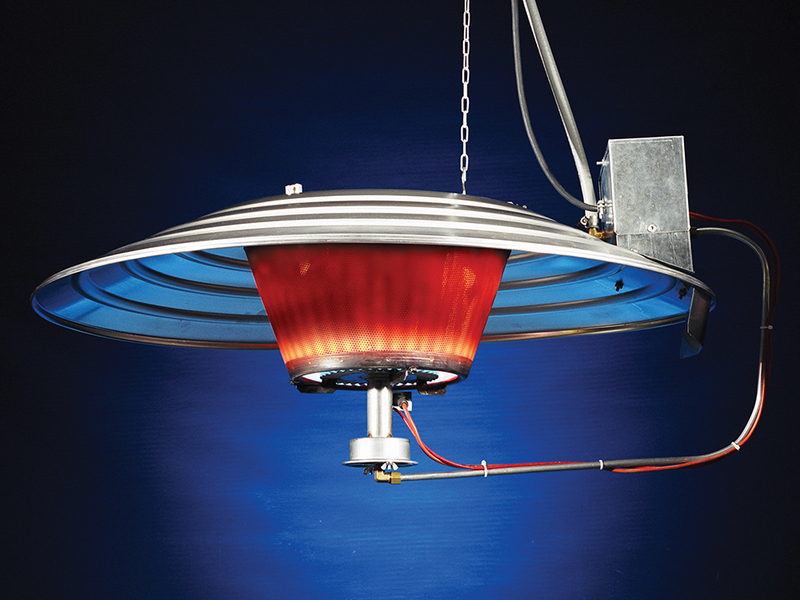
During operation, fuel gas enters the burner at the designed supply pressure and mixes with combustion air. After ignition, the burner heats the radiant emitter until it reaches the operating temperature required to generate infrared radiation.
The heated emitter transfers radiant energy toward birds, bedding and floor surfaces below the brooder. The reflector canopy helps redirect and spread this energy across the target brooding zone, producing a wider floor-level heat pattern than a small point-source heater.
Birds can move within or outside the radiant comfort zone according to their thermal requirements. Proper heater quantity, spacing and suspension height are therefore determined according to bird type, age, stocking density, building insulation and local climate.
When connected to a poultry house controller, heating demand can be coordinated with temperature sensors and the livestock ventilation system. This allows brooding heat and minimum ventilation to operate as parts of the same environmental-control strategy.
|
| Technical Specifications |
- Product Type: Low pressure gas-fired radiant poultry brooder
- Heating Method: Infrared radiant heating
- Primary Application: Poultry brooding and localized livestock heating
- Heat Input: Customizable
- Fuel Type: LPG / propane or natural gas according to project requirements
- Gas Supply Pressure: According to selected burner configuration and local gas system requirements
- Ignition Method: Available upon request
- Reflector / Canopy: Aluminum, coated metal or other suitable configuration according to project requirements
- Radiant Emitter: High-temperature corrosion-resistant configuration
- Heating Coverage: According to heater output, installation height and farm conditions
- Installation Height: Designed according to bird type, building layout and heater configuration
- Heater Spacing: According to project heat-load calculation and brooding layout
- Control Method: Individual, zone or house environmental control according to project requirements
- Electrical Supply: According to selected ignition and control configuration
- Gas Hose / Connection: Available according to project requirements
- Regulator: Available upon request where required by the gas system design
- Dimensions: Available upon request
- Safety Clearances: According to final model, installation manual and local regulations
- Operating Environment: Designed according to local climate and farm conditions
- OEM / ODM: Available upon request
|
| Applications |
- Broiler Houses: Radiant brooding heat for chicks during early production stages.
- Breeder Farms: Localized heating for breeder chick and pullet production facilities.
- Turkey Farms: Brooding heat for poults where gas radiant systems are specified.
- Layer Pullet Houses: Temperature support during early rearing stages.
- Large Poultry Complexes: Multiple-zone radiant heating integrated with centralized environmental controls.
- Open-Floor Poultry Houses: Floor-level heat distribution for litter-based production systems.
- Cold-Climate Poultry Farms: Supplemental radiant heat during low outdoor temperatures.
- Poultry Farm Renovation: Replacement or upgrading of existing brooding heater systems.
- Steel Structure Building Projects: Suspended heating equipment for modern agricultural steel structure poultry houses.
- Integrated Agricultural Projects: Heating equipment supplied together with ventilation, cooling and other livestock equipment.
|
| Customization Options |
- Heating Capacity: Selected according to poultry house heat load and required brooding coverage.
- Fuel Configuration: LPG / propane or natural gas options according to project requirements.
- Ignition System: Suitable ignition and flame-control configuration available upon request.
- Reflector Design: Canopy dimensions and material can be selected according to required heat distribution.
- Control Interface: Individual thermostat, zone-control or house-controller integration available upon request.
- Suspension Arrangement: Chain, cable or customized hanging system according to steel structure building layout.
- Gas Accessories: Hose, regulator, valve and connection accessories can be configured according to the project gas system.
- OEM Supply: Packaging, labels and technical documentation can be prepared for distributors, agents and agricultural project buyers.
|
| Installation & Maintenance |
Heating Layout
Heater quantity, spacing and installation height should be determined from poultry type, brooding density, building dimensions, insulation performance, required floor temperature, local winter conditions and minimum ventilation requirements. Large commercial houses should use a coordinated heating and ventilation layout rather than selecting brooders by floor area alone.
Suspension Installation
Suspend each brooder from a structurally suitable roof member or approved support. Installation height and required clearances from ceilings, litter, walls, equipment and combustible materials must follow the specifications of the final supplied model and applicable local regulations.
Gas Supply System
Gas piping, regulators, shut-off valves, hoses and burner connections must be sized and installed by qualified personnel. Gas type, supply pressure and burner configuration must match the approved equipment. All connections should be leak-tested before commissioning.
Ventilation Requirements
Gas-fired brooders consume combustion air and release combustion products into the livestock building. The poultry house must therefore provide ventilation according to local codes, animal requirements and heater manufacturer instructions. The livestock ventilation system should remain coordinated with heating operation throughout the brooding period.
Commissioning
Confirm correct ignition, flame condition, gas pressure, controller response and temperature-sensor operation before placing birds in the heated area. Observe floor-level temperature distribution and bird behavior, then adjust heater height or control settings where necessary.
Routine Maintenance
- Shut off gas and electrical power before servicing the brooder.
- Inspect the burner, radiant emitter and air openings for dust, feathers and litter accumulation.
- Clean the reflector carefully to maintain effective radiant heat distribution.
- Inspect gas hoses, piping and fittings for damage, aging or leakage.
- Check ignition electrodes, flame-sensing components and wiring where applicable.
- Inspect suspension chains, hooks and roof supports at regular intervals.
- Verify thermostat, sensor and environmental-controller operation before each brooding cycle.
- Keep required clearances around the heater free from combustible materials and obstructions.
- Use only replacement components suitable for the specific heater configuration.
|
| Project Cases |
Representative Project Scenario 1 – Commercial Broiler Farm:
A large broiler house requires localized heating during chick placement and early growth. Low pressure radiant brooders are suspended above the litter floor in multiple heating zones, with temperature sensors connected to the house environmental controller.
Representative Project Scenario 2 – Poultry Farm Expansion:
An existing farm adds new steel structure building houses and requires heating equipment compatible with a centralized gas supply. Brooder capacity, gas configuration, suspension layout and controller connections are selected according to the new house design.
Representative Project Scenario 3 – Turkey Production:
A turkey farm requires radiant brooding heat for young poults. Heater spacing and installation height are designed according to bird requirements, floor layout, building insulation and local winter conditions.
Representative Project Scenario 4 – Integrated Poultry Project:
An agricultural engineering company requires brooders together with ventilation fans, air inlets, cooling equipment and environmental controls. SHEWUYOU coordinates the heating layout with the complete livestock ventilation system and other livestock equipment supplied for the project.
|
| Product FAQ |
Q1: What is a low pressure gas radiant brooder?
A: It is a suspended gas-fired heater that uses a radiant emitter and reflector to direct infrared heat toward birds, litter and the poultry-house floor while operating from a designed low-pressure gas supply system.
Q2: Is this brooder suitable for commercial broiler houses?
A: Yes. It is designed for commercial poultry brooding applications where localized radiant floor heating is required.
Q3: Can it operate with both propane and natural gas?
A: LPG / propane and natural gas configurations are available according to project requirements. The correct burner orifice, regulator and gas-system components must be selected for the specified fuel.
Q4: Can the brooders connect to a poultry house environmental controller?
A: Yes. Suitable ignition and control configurations can be integrated with zone controls or central poultry-house environmental control systems.
Q5: How many brooders are required in one poultry house?
A: Quantity depends on heat output, required floor coverage, house dimensions, insulation, stocking density, bird type and local climate. A project-specific heating layout is recommended.
Q6: How high should the brooder be installed?
A: Installation height depends on heater configuration, bird type, heat distribution requirements and safety clearances. Final dimensions should follow the supplied installation instructions.
Q7: Does a gas radiant brooder require ventilation?
A: Yes. Gas-fired heaters require adequate combustion air and ventilation. Heating operation should be coordinated with the livestock ventilation system according to project requirements and local regulations.
Q8: What information is required for product selection?
A: Please provide poultry type, house dimensions, bird capacity, local minimum temperature, required indoor temperature, insulation information, fuel type, available gas pressure, electrical supply and control requirements.
Q9: Can SHEWUYOU provide brooders for distributors and agents?
A: Yes. OEM packaging, labeling, project configurations and commercial supply arrangements are available upon request for distributors, agents and livestock equipment suppliers.
Q10: Can brooders be supplied as part of a complete poultry project?
A: Yes. Brooding heaters can be coordinated with fans, air inlets, cooling systems, environmental controllers, steel structure building components and other livestock equipment for integrated agricultural project supply.
|
| Product Gallery |
 |


Comments & Inquiries
Leave your questions or requirements below. We will reply as soon as possible.