| Product Name |
Tire Spray Disinfection Module |
| Product Image |
 |
| Product Overview |
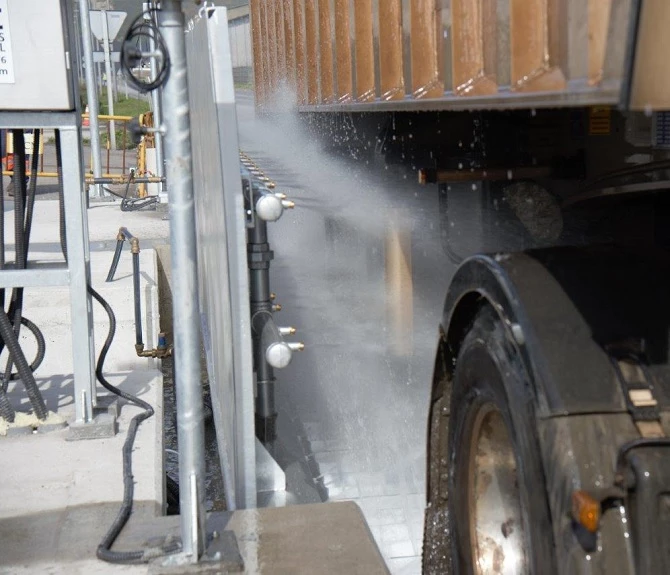
The Tire Spray Disinfection Module is a modular vehicle biosecurity component designed to deliver disinfectant spray directly toward vehicle tyres, wheels and adjacent lower vehicle surfaces. It can be integrated into fixed or modular vehicle disinfection systems at commercial livestock farms, poultry facilities, breeding farms, feed mills and agricultural production sites.
The module uses strategically positioned spray lines and nozzles to create a controlled treatment zone around the wheel area. It can be connected to a central pump, filtration system and chemical dosing unit, allowing the complete installation to be engineered around the farm's vehicle traffic and biosecurity procedure.
Its modular structure simplifies project planning and makes it suitable for new pig farm construction, poultry farm construction and farm renovation projects where tire disinfection needs to be incorporated into the vehicle entrance layout.
Module dimensions, spray coverage, nozzle quantity, connection configuration and structural materials can be customized according to vehicle dimensions, local climate, disinfectant compatibility and project requirements. |
| Key Features |
- Targeted Tire Treatment: Spray nozzles are positioned to direct disinfectant toward vehicle tyres and wheel areas.
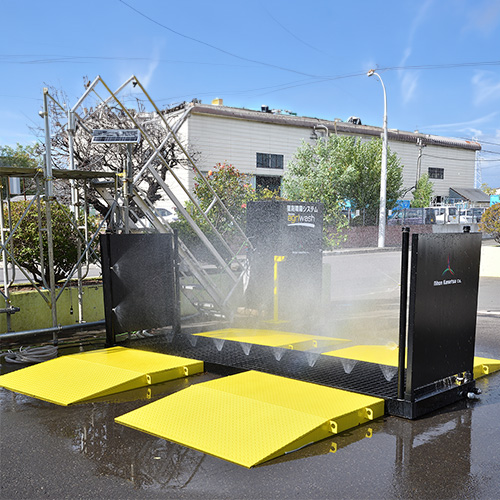
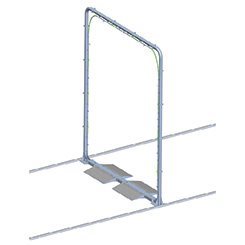
- Modular Construction: The spray assembly can be combined with platforms, pumps, dosing equipment and vehicle disinfection arches.
- Distributed Nozzle Coverage: Multiple spray points help create a more consistent treatment zone around the wheels.
- Vehicle Biosecurity Integration: Designed as part of a controlled vehicle sanitation point at farm entrances.
- Automatic Operation: Can be connected to photocells, vehicle sensors or other control devices for automatic activation.
- Chemical Dosing Compatibility: Can work with a compatible dosing system to prepare the disinfectant solution according to the approved farm procedure.
- Corrosion-Resistant Structure: Galvanized steel and stainless steel components can be selected for demanding agricultural environments.
- Flexible Installation: Suitable for integration into surface-mounted platforms or purpose-designed vehicle disinfection structures.
- Easy System Integration: Connection piping and flexible hoses can be configured according to the pump and spray layout.
- Heavy Vehicle Applications: Structural support can be engineered for commercial livestock trucks, feed trucks and agricultural vehicles.
- Project-Specific Design: Spray height, nozzle positioning, module dimensions and connection points are customizable.
- Expandable Configuration: Additional chassis, undercarriage or side-spray modules can be incorporated where broader vehicle coverage is required.
|
| Structural Components |
- Galvanized Support Frame: Provides the structural base for the wheel spray assembly.
- Spray Line: Flexible or rigid pipework distributes the disinfectant solution to the individual nozzles.
- Spray Nozzles: Fine spray nozzles direct the treatment solution toward tyres and wheel surfaces.
- Mounting Brackets: Secure spray lines to the structural frame while allowing project-specific nozzle positioning.
- Connection Fittings: Inlet and outlet fittings connect the module to the main pump and spray circuit.
- Flexible Connection Hose: Provides a practical connection between the module and the pump or main distribution line.
- Protection Structure: Optional protective components can shield spray lines and nozzles from vehicle contact.
- Drainage Interface: The module can be installed above a platform or collection area connected to the site's wastewater system.
- Control Interface: Can be integrated with photocells, pressure controls, solenoid valves and automatic vehicle detection systems.
|
| Working Principle / Structural Principle |
The Tire Spray Disinfection Module works as part of a pressurized vehicle sanitation circuit. A pump supplies the prepared disinfectant solution through the main distribution pipe or flexible connection hose.
When the vehicle enters the treatment area, a photocell, vehicle sensor or manual control can activate the spray circuit. The solution is distributed through the module's spray line and discharged from multiple nozzles toward the tyres and wheel areas.
The spray arrangement can be positioned at different heights and angles to improve contact with tyre sidewalls, tread areas and accessible wheel surfaces. Additional low-level spray lines can be incorporated when treatment of lower chassis areas is required.
After the programmed treatment cycle, the control system can stop the pump and close the relevant valve. The module can then remain ready for the next vehicle.
For complete vehicle biosecurity, the tire module can be combined with an undercarriage spray system, overhead or side disinfection arch, chemical dosing unit, filtration system and wastewater collection arrangement. |
| Technical Specifications |
| Product Type |
Modular tire and wheel spray disinfection assembly |
| Primary Application |
Vehicle tyre and wheel disinfection |
| Installation Type |
Fixed or integrated modular installation |
| Reference Structure |
Galvanized steel support structure with corrosion-resistant spray components; customizable |
| Reference Nozzle Configuration |
A comparable wheel and frame module uses 16 fog nozzles; final quantity according to project requirements |
| Reference Support Structure |
Comparable modular configurations use galvanized base frames and support struts; dimensions customizable |
| Pump System |
External pump module; flow and pressure according to project requirements |
| Chemical Dosing |
Compatible external dosing and filtration system; available according to project requirements |
| Automatic Activation |
Photocell, vehicle sensor or control system; customizable |
| Spray Coverage |
Tyres and wheel areas; optional chassis and undercarriage coverage |
| Connection |
Flexible hose or rigid pipe connection according to system design |
| Electrical System |
According to the selected pump and control configuration and local electrical standards |
| Dimensions |
Customizable according to vehicle dimensions and installation layout |
| Material Selection |
Galvanized steel, stainless steel and other suitable materials available upon request |
Reference configuration data are based on a comparable modular vehicle disinfection system. Final nozzle quantity, pressure, flow rate, dimensions, material specification and control configuration should be confirmed according to the project design.
|
| Applications |
- Commercial Pig Farms: Tire disinfection for feed trucks, livestock transporters and service vehicles entering controlled farm areas.
- Poultry Farms: Vehicle wheel sanitation at poultry farm entrances and biosecurity checkpoints.
- Cattle and Dairy Farms: Vehicle disinfection for livestock production and animal transport facilities.
- Breeding Farms: Controlled wheel treatment between clean and potentially contaminated areas.
- Feed Mills: Integration into vehicle sanitation systems for delivery and logistics vehicles.
- Livestock Transport Facilities: Modular wheel spray systems for trucks and trailers.
- Veterinary Facilities: Vehicle sanitation equipment for controlled-access agricultural and animal-health facilities.
- New Farm Construction: Integration into the vehicle biosecurity zone during pig farm or poultry farm construction.
- Farm Renovation: Retrofit solution for existing vehicle disinfection platforms and entrance systems.
- Agricultural Engineering Projects: Suitable for engineering companies, farm groups, distributors and project contractors.
|
| Customization Options |
- Module Dimensions: Designed according to vehicle width, wheel position and available installation space.
- Nozzle Quantity: Selected according to required spray coverage and vehicle configuration.
- Nozzle Position: Spray angle, height and spacing can be adjusted according to tyre and wheel geometry.
- Spray Pressure: Pump and nozzle selection can be matched to the required spray pattern.
- Flow Rate: Designed according to nozzle quantity, disinfectant application procedure and system capacity.
- Structural Material: Galvanized steel or stainless steel options can be selected according to local climate and chemical exposure.
- Automatic Control: Photocells, vehicle sensors, solenoid valves and programmable controls can be integrated.
- System Integration: Compatible with pump modules, chemical dosing units, filtration systems, spray arches and undercarriage spray modules.
- Traffic Configuration: Single-direction or two-way vehicle traffic layouts can be accommodated.
- Drainage: Installation can be coordinated with collection trays, floor drains and farm wastewater systems.
- Farm Engineering: Module layout can be designed according to the civil engineering plan and farm biosecurity zoning.
- OEM / ODM: Custom drawings, technical documentation, branding and packaging are available upon request.
|
| Installation & Maintenance |
Installation: The module should be installed on a stable structure or vehicle disinfection platform designed for the expected traffic conditions. For new livestock projects, the module can be incorporated into the entrance roadway and vehicle biosecurity zone during the engineering stage.
- Confirm vehicle width, wheel position, tyre dimensions and traffic direction.
- Prepare the support structure or platform according to the approved installation drawing.
- Position the spray module at the specified height and distance from the vehicle path.
- Secure the support frame, spray lines, brackets and protective components.
- Connect the module to the pump and chemical dosing system.
- Install vehicle detection sensors or photocells where automatic operation is required.
- Check all pipe connections, fittings and spray nozzles before commissioning.
- Test spray direction, coverage, flow and pressure with the selected operating solution.
- Inspect nozzles regularly and remove dirt, sediment or chemical deposits.
- Clean the filtration system according to the operating environment.
- Inspect flexible hoses, fittings, brackets and support structures for wear.
- Flush the spray circuit according to the disinfectant manufacturer's instructions.
- Keep the treatment area free from mud, manure and excessive organic contamination.
- Inspect drainage and wastewater connections regularly to prevent blockage.
- Follow the disinfectant manufacturer's label, safety data sheet and approved farm biosecurity SOP.
|
| Product FAQ |
Q: What is a Tire Spray Disinfection Module?
A: It is a modular spray assembly designed to apply a compatible disinfectant solution to vehicle tyres and wheel areas as part of a farm vehicle biosecurity system.
Q: Is the module a complete vehicle disinfection system?
A: The module is primarily a wheel and tire treatment component. It can be combined with a pump, chemical dosing unit, control system, spray arch and undercarriage modules to create a complete vehicle disinfection installation.
Q: Where is the module installed?
A: It is normally installed alongside or beneath a vehicle passage, platform or disinfection structure so the spray nozzles can target the vehicle tyres and wheel areas.
Q: Can it be used for commercial pig farms?
A: Yes. It is suitable for commercial pig farms, poultry farms, cattle farms, breeding facilities, feed mills and other agricultural sites requiring controlled vehicle sanitation.
Q: Can the module work automatically?
A: Yes. It can be connected to photocells, vehicle detection sensors, solenoid valves and a control cabinet for automatic spray activation.
Q: Can the nozzle layout be customized?
A: Yes. Nozzle quantity, spacing, height and spray direction can be designed according to vehicle dimensions, tyre position and required treatment coverage.
Q: What materials are available?
A: Galvanized steel and stainless steel are suitable options for many agricultural installations. Final material selection should consider local climate, disinfectant compatibility and project requirements.
Q: Can the module also treat the chassis?
A: Additional low-level spray lines or an undercarriage spray module can be integrated when treatment of accessible chassis and lower vehicle surfaces is required.
Q: Does it require a separate pump?
A: The module can be supplied as part of a complete system with a dedicated pump module. Pump flow and pressure should be selected according to the final nozzle configuration and application requirements.
Q: Can SHEWUYOU customize the module for a farm construction project?
A: Yes. Module dimensions, nozzle configuration, support structure, materials, piping, pump connection, automatic control and drainage interface can be designed according to project requirements and local farm conditions.
|
| Product Gallery |

|


Comments & Inquiries
Leave your questions or requirements below. We will reply as soon as possible.