


| Product Name | Poultry Tunnel Ventilation Air Inlet Door |
| Product Image | 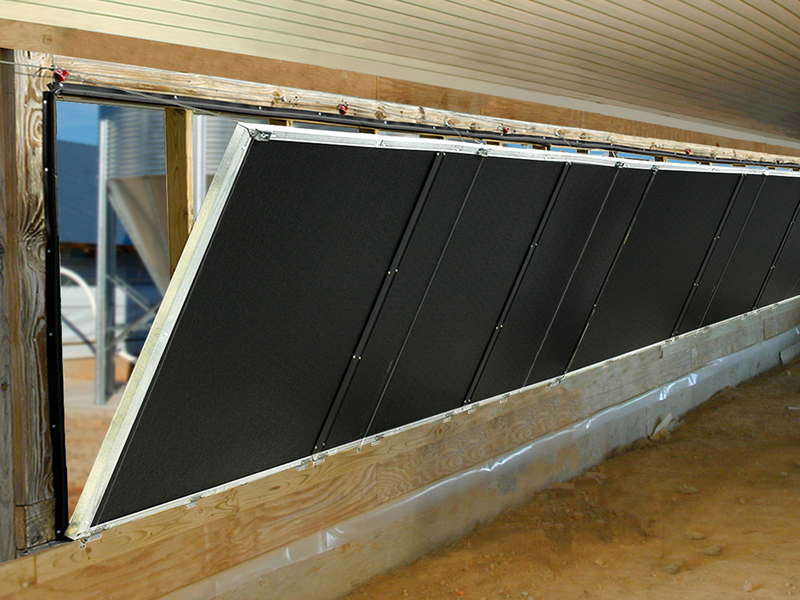 |
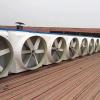
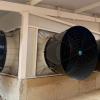
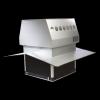
| Product Overview | The Poultry Tunnel Ventilation Air Inlet Door is a large-area fresh-air inlet designed for commercial poultry houses equipped with tunnel or CombiTunnel ventilation. Installed at the gable end or near the end wall, it provides a controlled opening for high-volume fresh-air intake. During tunnel ventilation, exhaust fans create negative pressure and draw outdoor air through the inlet. The large opening allows fresh air to enter over a broad area and travel through the house toward the exhaust fans. Properly designed inlet area, opening position, static pressure, and fan capacity work together to establish the required airflow pattern. The door can be equipped with insulation, sealing components, and motorized opening mechanisms according to building construction, climate conditions, and ventilation requirements. Large tunnel inlets are commonly used in commercial poultry projects where high airflow capacity and controlled summer ventilation are required. |
| Key Features |
|
| Structural Components | A typical tunnel ventilation air inlet door may include:
|
| Working Principle / Structural Principle | In tunnel ventilation mode, exhaust fans installed at the opposite end of the poultry house generate negative pressure. The pressure difference draws fresh outdoor air through the large tunnel inlet door. The incoming air is introduced over a large opening and moves longitudinally toward the exhaust end. This high-volume airflow can create an effective wind-chill effect at bird level during hot-weather operation. The actual air velocity and ventilation performance depend on house dimensions, fan capacity, inlet area, static pressure, and climate-control settings. The door opening can be adjusted according to the required ventilation stage. When tunnel ventilation is not required, the door can be closed to reduce uncontrolled air exchange and maintain the building envelope. |
| Technical Specifications |
|
| Applications | The Poultry Tunnel Ventilation Air Inlet Door is suitable for:
|
| Customization Options | The tunnel inlet door can be engineered according to the complete poultry house ventilation design:
|
| Installation & Maintenance | The tunnel air inlet door should be installed in the designated intake section and securely connected to the poultry house structure. For steel structure buildings, the opening frame, wall panels, insulation, structural members, and door support should be coordinated during the construction stage. The inlet position should be determined together with exhaust fan capacity and the overall tunnel ventilation calculation. The operating mechanism must be correctly aligned so that the door opens and closes smoothly throughout its working range. Routine maintenance includes checking the door panel, frame, hinges or guide components, rack-and-pinion or linkage system, actuator, sealing elements, and mounting hardware. Dust, feathers, and other debris should be removed regularly. Seals should be inspected for wear to maintain effective closure. |
| Project Cases | Large tunnel air inlet doors are widely applicable to commercial poultry houses requiring high-volume fresh-air intake during tunnel ventilation. Typical projects include broiler farms, breeder farms, turkey production buildings, large steel structure poultry houses, and CombiTunnel systems. The inlet can be positioned at the gable end or near the gable depending on the building design. For complete projects, the inlet area and opening arrangement should be engineered together with exhaust fans, evaporative cooling equipment, static pressure, house cross-section, and required airflow. |
| Product FAQ | Q: What is a poultry tunnel ventilation air inlet door? A: It is a large controlled opening used to introduce fresh air into a poultry house during tunnel ventilation. It is normally installed at or near the gable end opposite the exhaust fans. Q: What is the main function of the tunnel inlet door? A: It provides a large effective inlet area for high-volume fresh-air intake and helps establish longitudinal airflow through the poultry house. Q: Can the door dimensions be customized? A: Yes. Door dimensions and opening area can be designed according to building dimensions, exhaust fan capacity, required airflow, and project requirements. Q: Can the tunnel door be insulated? A: Yes. Insulated door panels can be specified where thermal separation and reliable closure are required. Non-insulated configurations are also available according to climate and project requirements. Q: Can the door be automatically controlled? A: Yes. Motorized actuators, rack-and-pinion drives, winches, or other suitable mechanisms can be integrated with an automatic poultry climate-control system. Q: Can it be used in a CombiTunnel system? A: Yes. Large tunnel inlet doors can be incorporated into CombiTunnel ventilation systems and operated together with other air inlets and exhaust equipment according to the selected ventilation mode. Q: Can a light-control system be added? A: Yes. Light-trap or dark-out components can be considered for poultry houses where controlled light levels are required. |
| Product Gallery |  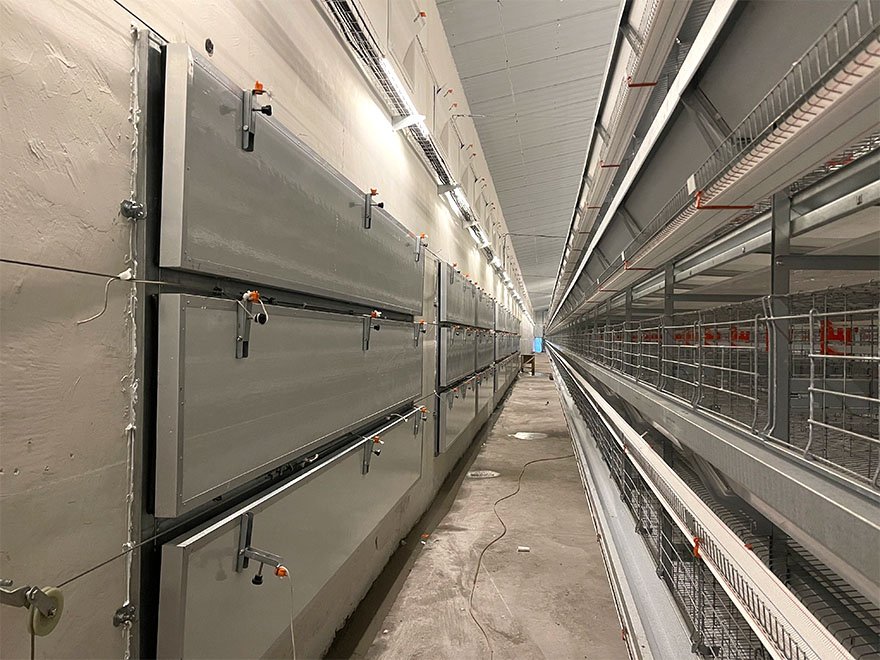 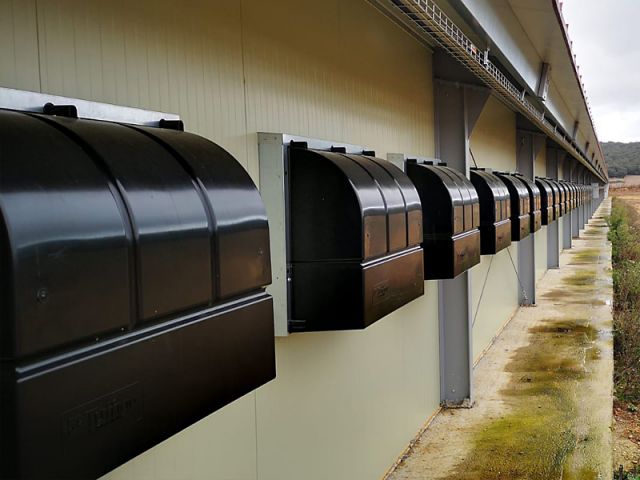 |
- Home
-
Products
- Pig Farming Equipment
- Cattle Farming Equipment
- Sheep & Goat Farming Equipment
- Poultry Farming Equipment
- Feeding & Drinking Systems
- Veterinary & Breeding Equipment
- Testing & Diagnostic Equipment
- Cleaning & Biosecurity Equipment
- Climate Control Equipment
- Livestock Weighing Equipment
- Manure & Waste Management
- Farm Transport & Handling
-
Solutions
- Pig Farm Solutions
- Dairy Farm Solutions
- Beef Cattle Farm Solutions
- Sheep & Goat Farm Solutions
- Layer Farm Solutions
- Broiler Farm Solutions
- Feeding & Drinking System Solutions
- Climate Control Solutions
- Biosecurity & Disinfection Solutions
- Manure & Waste Management
- Smart Farming Solutions
- Farm Renovation and Upgrade Solutions
- Partners
- Projects
- Resources
- News
- About Us
- Contact



Comments & Inquiries
Leave your questions or requirements below. We will reply as soon as possible.