



| Product Name | HVLS Livestock Ceiling Fan |
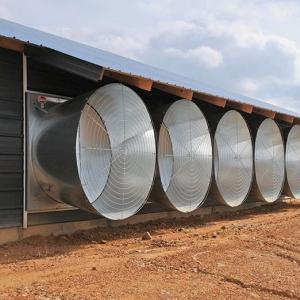
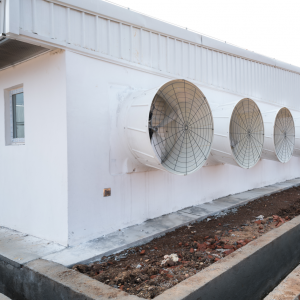
| Product Image | 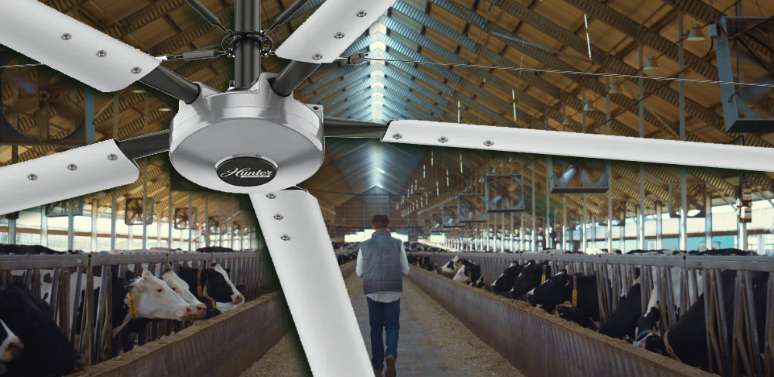 |
| Product Overview | The HVLS Livestock Ceiling Fan is a large-diameter, high-volume, low-speed air circulation solution developed for commercial livestock buildings. It produces a broad, gentle airflow pattern across large floor areas, helping improve air distribution, reduce stagnant zones, and support a more uniform indoor environment. The fan is suitable for commercial pig farms, dairy barns, cattle housing, poultry facilities, equestrian buildings, and large agricultural steel structure buildings. HVLS fans can complement exhaust fans and natural or mechanical ventilation systems as part of an integrated livestock climate-control strategy. |
| Key Features | • High-volume, low-speed airflow for large livestock buildings • Large coverage area with broad and relatively low-velocity airflow • Helps reduce stagnant air and temperature stratification • Supports animal cooling during warm-weather operation • Helps improve indoor air mixing and moisture distribution • Suitable for year-round air circulation in commercial livestock facilities • Direct-drive motor configuration available according to project requirements • Low-noise configuration available for livestock environments • Suitable for integration with ventilation controls and farm climate-management systems • Fan diameter and configuration can be selected according to building size and airflow requirements |
| Structural Components | The typical HVLS fan assembly consists of a large-diameter aerodynamic blade set, central motor and drive unit, blade hub, structural supports, safety components, suspension system, downrod, and electrical control components. Direct-drive construction can reduce the number of mechanical transmission components and simplify the overall drive system. Blade materials, protective finishes, motor enclosure, mounting hardware, and corrosion protection can be selected according to the livestock environment and project requirements. For agricultural steel structure buildings, the suspension assembly should be coordinated with the roof truss, purlins, support members, and structural load requirements. |
| Working Principle / Structural Principle | The motor rotates the large-diameter blades at relatively low speed, generating a wide column of moving air. The airflow travels downward and then spreads outward across the occupied area, creating continuous circulation throughout the livestock building. The large blade diameter allows the fan to move a substantial volume of air over a broad area. The resulting air movement can help redistribute warmer air accumulated near the roof and improve mixing between different air layers. In warm conditions, air movement across livestock can support evaporative cooling and help reduce the effects of heat stress. HVLS fans are intended to complement, rather than replace, dedicated fresh-air inlets and exhaust ventilation equipment. Fan layout should be developed according to the complete ventilation strategy. |
| Technical Specifications | Fan diameter: Customizable Airflow capacity: According to project requirements Motor type: Direct-drive or other suitable configuration, available upon request Motor power: Customizable Operating speed: According to selected configuration Voltage and frequency: Designed according to local electrical standards Control method: Customizable Suspension length: According to building structure and project requirements Mounting system: Customizable Protection rating: Available upon request Blade material and finish: According to project requirements Final specifications should be selected according to barn dimensions, ceiling height, livestock type and density, required airflow coverage, structural capacity, local climate, and electrical standards. Professional HVLS livestock fan ranges are available in different diameters for different agricultural building sizes. |
| Applications | • Commercial pig farms and swine production buildings • Farrowing, nursery, and finishing houses • Dairy barns and cattle housing • Poultry and livestock buildings • Horse and equestrian facilities • Agricultural steel structure buildings • Large-scale livestock production complexes • New farm construction and ventilation renovation projects HVLS ceiling fans are particularly suitable for large open agricultural spaces where wide-area air circulation, air destratification, and animal cooling are required. |
| Customization Options | The HVLS Livestock Ceiling Fan can be configured for different livestock housing layouts, structural conditions, electrical standards, and ventilation concepts. Customization may include fan diameter, blade configuration, motor specification, voltage, control system, suspension length, mounting hardware, structural connection, blade material, protective treatment, and environmental protection. Solutions are designed according to local climate and farm conditions, barn dimensions, ceiling height, livestock density, ventilation strategy, structural capacity, and applicable electrical standards. For large commercial projects, multiple HVLS fans can be coordinated with circulation fans, exhaust fans, air inlets, and cooling equipment to develop a complete airflow plan. |
| Installation & Maintenance | The fan is suspended from an engineered building support using a downrod and mounting assembly. For steel structure livestock buildings, installation should be coordinated with roof trusses, purlins, support frames, and structural load calculations. Installation height, fan spacing, airflow direction, and suspension length should be determined during the ventilation planning stage. Adequate clearance should be maintained from roof members, lighting, feeding equipment, sprinklers, and other building services. Routine maintenance should include inspection and cleaning of blades, checking suspension components and structural fasteners, inspecting electrical connections, and verifying motor and controller operation. Maintenance intervals should be adjusted for dust, humidity, ammonia exposure, and operating hours. Due to the size and weight of HVLS equipment, installation should be carried out by qualified personnel following the applicable installation instructions and local safety requirements. |
| Project Cases | The HVLS Livestock Ceiling Fan is suitable for large-scale agricultural engineering projects, including commercial pig farms, dairy barns, cattle facilities, equestrian buildings, poultry houses, and agricultural steel structure buildings. A documented dairy project from Hunter Industrial used multiple 14-foot HVLS fans in a 500 × 150 ft open-face barn. The project illustrates the use of large ceiling fans as part of a livestock airflow strategy. :contentReference[oaicite:1]{index=1} For project procurement, fan quantity, diameter, mounting position, airflow direction, and control configuration should be developed according to building dimensions, livestock capacity, climate conditions, structural layout, and the complete ventilation strategy. |
| Product FAQ | Q: What does HVLS mean? A: HVLS stands for High Volume, Low Speed. HVLS fans use large-diameter blades rotating at relatively low speed to move substantial volumes of air across large areas. Q: Can an HVLS fan be used in a commercial pig farm? A: Yes. HVLS fans can be incorporated into livestock ventilation systems to improve air circulation and support animal cooling in commercial agricultural buildings. Q: Is an HVLS fan a replacement for an exhaust fan? A: No. An HVLS fan primarily circulates and redistributes indoor air. It can complement exhaust fans, fresh-air inlets, cooling systems, and other ventilation equipment. Q: How is the fan size selected? A: Fan diameter and quantity should be selected according to building dimensions, ceiling height, livestock density, airflow requirements, structural conditions, and the overall ventilation design. Q: Can the fan be customized for international farm projects? A: Yes. Electrical specifications, fan diameter, suspension arrangement, control system, materials, and protection options can be configured according to project requirements and local standards. Q: Can HVLS fans operate together with other ventilation equipment? A: Yes. HVLS fans can complement exhaust fans and natural or mechanical ventilation systems to improve overall air movement inside livestock buildings. |
| Product Gallery |    |
- Home
-
Products
- Pig Farming Equipment
- Cattle Farming Equipment
- Sheep & Goat Farming Equipment
- Poultry Farming Equipment
- Feeding & Drinking Systems
- Veterinary & Breeding Equipment
- Testing & Diagnostic Equipment
- Cleaning & Biosecurity Equipment
- Climate Control Equipment
- Livestock Weighing Equipment
- Manure & Waste Management
- Farm Transport & Handling
-
Solutions
- Pig Farm Solutions
- Dairy Farm Solutions
- Beef Cattle Farm Solutions
- Sheep & Goat Farm Solutions
- Layer Farm Solutions
- Broiler Farm Solutions
- Feeding & Drinking System Solutions
- Climate Control Solutions
- Biosecurity & Disinfection Solutions
- Manure & Waste Management
- Smart Farming Solutions
- Farm Renovation and Upgrade Solutions
- Partners
- Projects
- Resources
- News
- About Us
- Contact

Comments & Inquiries
Leave your questions or requirements below. We will reply as soon as possible.