


| Product Name | Veterinary Iris Scissors | ||||||||||||||||||
| Product Image | 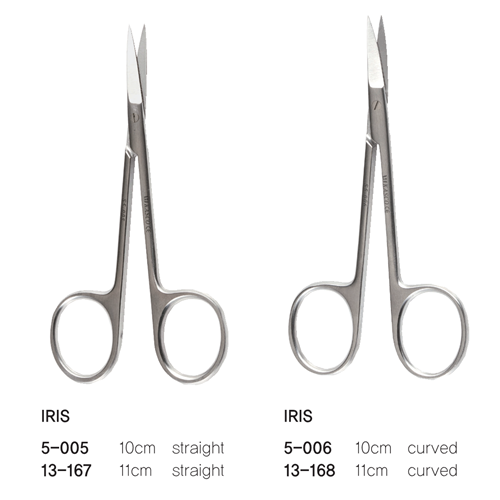 |
||||||||||||||||||
| Product Overview | Veterinary Iris Scissors are compact precision surgical scissors designed for controlled cutting and fine soft-tissue dissection in veterinary procedures. Their short blades and balanced finger-ring handles provide accurate tip control in confined surgical areas. Straight and curved patterns are commonly available to suit different surgical approaches. Straight blades are useful where a direct cutting line is required, while curved blades can improve access and visibility when trimming or dissecting tissue around anatomical contours. The reference veterinary range includes left-handed straight and curved iris scissors measuring approximately 11.5 cm, providing dedicated ergonomics for left-handed veterinary surgeons. :contentReference[oaicite:1]{index=1} |
||||||||||||||||||
| Key Features |
|
||||||||||||||||||
| Structural Components |
|
||||||||||||||||||
| Working Principle | Veterinary iris scissors operate through a pivoted two-blade mechanism. When the finger rings are closed, the sharpened blade edges pass across one another to create a controlled shearing action. The short blade length improves control at the cutting tip and makes the scissors suitable for fine dissection, trimming and suture-related work. Curved blades can assist when the tissue surface or surgical approach follows a contour, while straight blades provide a direct line of cut. Left-handed scissors use blade orientation designed to maintain proper cutting-edge contact when operated with the left hand rather than simply reversing a standard right-handed instrument. |
||||||||||||||||||
| Technical Specifications |
|
||||||||||||||||||
| Applications |
|
||||||||||||||||||
| Customization Options |
|
||||||||||||||||||
| Use & Maintenance | Inspect the scissors before each procedure to confirm that the blades are properly aligned, the pivot operates smoothly and the cutting edges are free from visible damage. Select straight or curved scissors according to the surgical approach and tissue being handled. Fine iris scissors should be reserved for delicate cutting tasks and should not be used for heavy tissue, wire or materials that could damage the cutting edges. After use, remove biological residue promptly and clean the instrument according to the veterinary facility's validated instrument-processing procedure. The hinge and joint area should be opened during cleaning so all surfaces can be adequately processed. Sterilize reusable scissors using a validated method suitable for the instrument material. Dry thoroughly before storage and periodically inspect blade sharpness, alignment and joint movement. |
||||||||||||||||||
| Product FAQ | What are veterinary iris scissors used for? They are used for precise cutting and fine soft-tissue dissection where compact blades and accurate tip control are required. What is the difference between straight and curved iris scissors? Straight scissors provide a direct cutting line, while curved scissors can improve visibility and access when working around anatomical contours. Are left-handed iris scissors available? Yes. The reference veterinary range includes dedicated left-handed straight and curved iris scissors measuring approximately 11.5 cm. :contentReference[oaicite:2]{index=2} Are iris scissors suitable for heavy tissue? No. Iris scissors are fine precision instruments and are better suited to delicate tissue and detailed surgical work than heavy fibrous tissue. Can the scissors be sterilized and reused? Yes. Reusable stainless steel veterinary scissors can be cleaned and sterilized according to the instrument manufacturer's instructions and the facility's validated sterilization protocol. |
||||||||||||||||||
| Product Gallery | |
- Home
-
Products
- Pig Farming Equipment
- Cattle Farming Equipment
- Sheep & Goat Farming Equipment
- Poultry Farming Equipment
- Feeding & Drinking Systems
- Veterinary & Breeding Equipment
- Testing & Diagnostic Equipment
- Cleaning & Biosecurity Equipment
- Climate Control Equipment
- Livestock Weighing Equipment
- Manure & Waste Management
- Farm Transport & Handling
-
Solutions
- Pig Farm Solutions
- Dairy Farm Solutions
- Beef Cattle Farm Solutions
- Sheep & Goat Farm Solutions
- Layer Farm Solutions
- Broiler Farm Solutions
- Feeding & Drinking System Solutions
- Climate Control Solutions
- Biosecurity & Disinfection Solutions
- Manure & Waste Management
- Smart Farming Solutions
- Farm Renovation and Upgrade Solutions
- Partners
- Projects
- Resources
- News
- About Us
- Contact


Comments & Inquiries
Leave your questions or requirements below. We will reply as soon as possible.